his section features questions and challenges that have either been posed directly by our readers, or forwarded to us for answering.
The following challenge is from Gaura Dasa, Caledon, Canada:
"The Publishers of "Back To Prabhupada" interpret in their own way when he said after when he is no longer with us, his officiating acaryas would create disciples, which would become his grand-disciples, disciples of his disciple. They never quote this. Why?"
[The May 28th, 1977 conversation dealing with initiations is then reproduced, which we have omitted here since it is already produced in full in the previous article.]
Editor replies:
1) It is claimed we do not accept that Srila Prabhupada stated "when he is no longer with us, his officiating acaryas would create disciples, which would become his grand-disciples, disciples of his disciple". But that instead we "interpret" in our own way. However, Srila Prabhupada states that "officiating acaryas" are "rtvik":
Srila Prabhupada: "I shall recommend some of you to act as officiating acaryas."
Tamala Krsna: "Is that called rtvik-acarya?"
Srila Prabhupada: "Rtvik, yes."
(Conversation, May 28th, 1977)
Therefore, this would mean that what is actually being claimed by Gaura Dasa is that:
"when he is no longer with us, his rtviks would create disciples, which would become his grand-disciples, disciples of his disciple."
This would mean that he is claiming that:
a) Srila Prabhupada created rtviks for when he is no longer with us.
b) These rtviks would then initiate disciples for themselves.
We agree that Statement a) is correct, as this means that the IRM has been correct all along that Srila Prabhupada appointed rtviks to conduct initiations in ISKCON for after he physically departs.
However, statement b) cannot be true, as it would be a contradiction to claim that a rtvik initiates disciples for himself. Because that would make him a diksa guru! But, a rtvik is not a diksa guru, nor is a "rtvik" just another word for diksa guru. Rather, the two are distinct entities since a rtvik makes disciples for the diksa guru, while a diksa guru makes disciples for himself.
2) It is further claimed that we "never quote" Srila Prabhupada speaking about the creating of "disciples, grand-disciples, disciples of his disciple". As noted above, we have omitted the questioner reproducing the conversation, because it is already produced in this very issue. Indeed, we have produced the quotes dealing with "grand-disciples" and "disciples of his disciples" in many issues. The following is a run-down of the 20 issues where we provide the quotes stating "grand-disciple" and "disciple of my disciple":
3, 4, 6, 16, 19, 23, 26, 28, 29, 33, 40, 52, 53, 56, 67, 72, 76, 78, 80, 82.
In addition, the quotes are also given in the BTP Special Summary Issue, BTP ISKCON Leaders Issue, and, of course, at the very outset almost 30 years ago, in The Final Order!
Thus, the claim that we "never quote this" is not only false, but patently absurd, given the sheer number of times we have provided the quotes. This means that:
i) Either the challenger does not read BTP and is thus making false claims.
ii) Or worse, he does read BTP, is lying, and knows he is lying!
So, the real question is not why we "never quote this", which is plainly untrue, but why the challenger has made such an obviously false statement.
Further, even though we have provided the quotes in question many times, they do not actually state what is claimed by the challenger that officiating acaryas/rtviks will act as diksa gurus, as anyone who reads the above-referenced issues will see.
 |
The following challenge is from B.V. Padmanabh, Secretary, International Gaudiya Vedanta Trust, New Delhi, India:
"This useless magazine full of fault finding of Vaishnava."
Editor replies:
3 charges are made against us:
1) That we engage in fault finding.
2) That this is done of Vaisnavas.
3) That this makes BTP "useless".
Let us take each of these charges in turn.
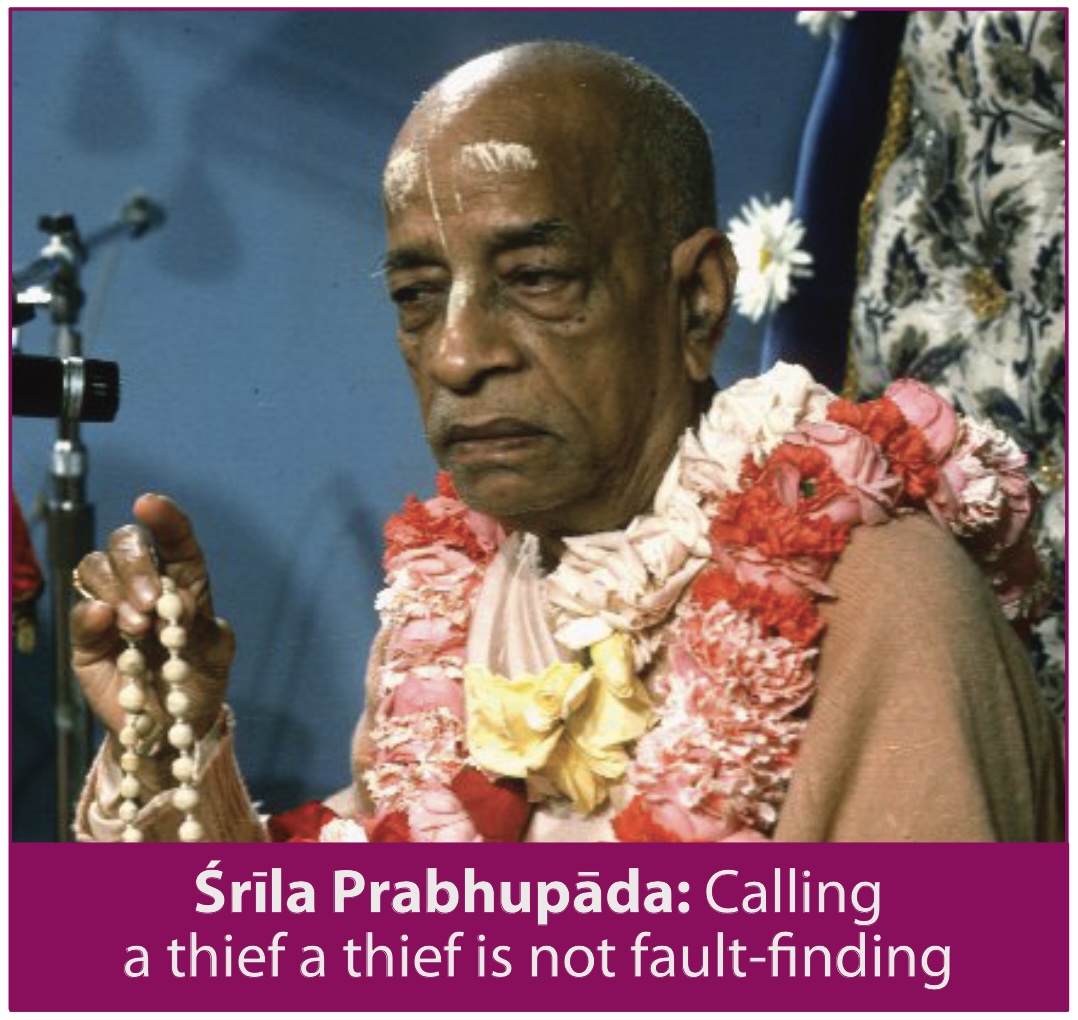
a) Beginning with No. 1), the charge of "fault finding". Luckily, Srila Prabhupada answers this question directly as follows:
"Apaisunam means that one should not find fault with others or correct them unnecessarily. Of course to call a thief a thief is not faultfinding, but to call an honest person a thief is very much offensive for one who is making advancement in spiritual life."
(Bg, 16.1-3, purport)
Thus, exposing faults is bona fide as long as it is not done when it is not necessary, which Srila Prabhupada means trying to point out faults that do not actually exist, i.e. one is making false statements about a person's supposed faults. And one can verify for oneself by studying BTP that we only speak the truth, rather than lies, about anyone. Therefore, BTP's content is approved by Srila Prabhupada.
In the last issue, in the article: "Srila Prabhupada Speaks Out: Criticism", we gave a special reference article specifically on the issue of "fault finding of Vaisnavas". Thus, this article will be very useful for answering this challenge, and devotees may consult it to get a more in-depth answer here.
b) In regard to point 2), that we fault-find "Vaisnavas", again, in the last issue, we gave an in-depth answer to the question of "What is a Vaisnava", and one can read that here.
c) Finally, in regard to point 3), that such "fault finding" by BTP makes the magazine "useless", we can note that the magazine exposes these "faults" specifically in relation to whether or not Srila Prabhupada's teachings are adhered to. It is hard to find something that could be more useful than ensuring we are following Srila Prabhupada correctly. For, without that, we do not actually have any spiritual life.
Subscribe for FREE to Back To Prabhupada Magazine - Click Here
Return to "Fault-finding" Index
Return to "May 28th, 1977 Tape" Index
Return to IRM Homepage