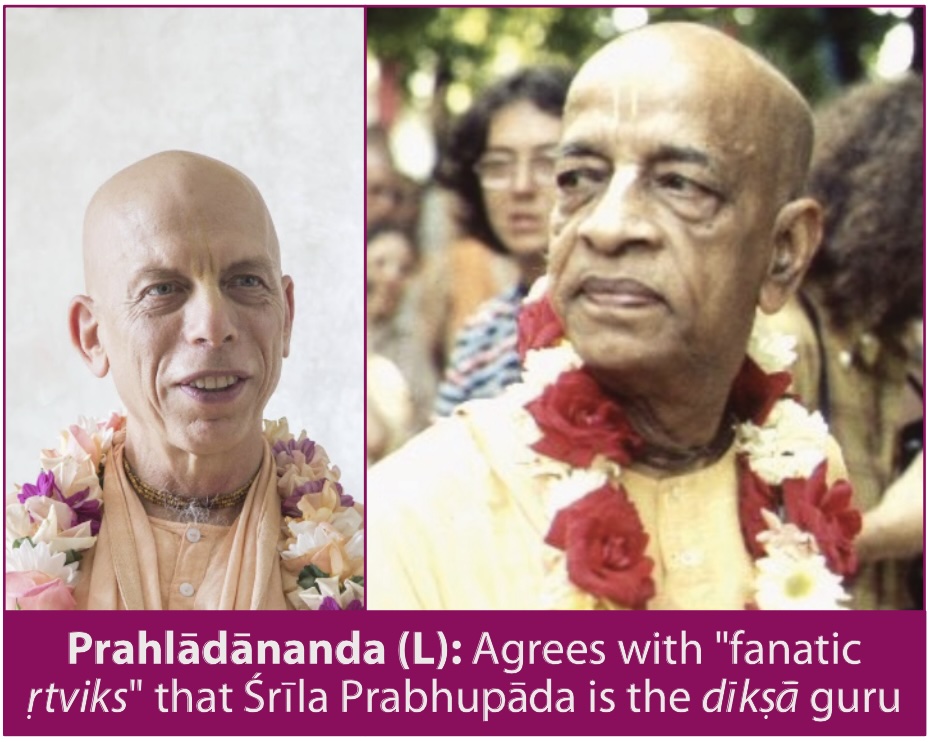
n our landmark book, Srila Prabhupada: The Founder-Acarya of ISKCON – Presenting the Conclusions of the GBC Foundational Document, we established that the GBC accepted (unwittingly) that Srila Prabhupada's position as the Acarya of ISKCON means he is also ISKCON's diksa guru. One evidence the GBC used to establish this conclusion was the purport to Sri Caitanya-caritamrta, Adi-lila, 1.46, wherein Srila Prabhupada describes the Acarya as the diksa guru. GBC voted-in guru HH Prahladananda Swami ("PAS") gave a class on the same verse (and surrounding verses) on 1/9/24, to claim that the Acarya is not also the diksa guru, titling his class: "Difference between an acarya and initiating spiritual master". The quotes in the shaded boxes are from this class.
Referring to the last 3 sentences of the purport to Adi-lila, 1.46, PAS says:
"So, this is specifically talking about the initiating guru, and specifically about the Acarya."
However, from start to finish, these sentences only mention the "spiritual master":
"In his prayers to the spiritual master, Srila Visvanatha Cakravarti Thakura confirms [...] the spiritual master to be identical with the Personality of Godhead [...] Gaudiya Vaisnavas therefore worship Srila Gurudeva (the spiritual master) [...] the spiritual master is always considered"
(Cc., Adi-lila, 1.46, purport)
Therefore, since PAS accepts that these sentences refer "specifically" to the initiating guru and the Acarya, but they only mention the "spiritual master", then the Acarya and initiating guru must be one and the same. Given that PAS also accepts that Srila Prabhupada will always be the Acarya for ISKCON –
"we accept Srila Prabhupada as our Acarya"
– then it would mean that PAS has to accept, just like the GBC did, that Cc., Adi-lila, 1.46 teaches Srila Prabhupada is also the initiating guru for ISKCON.
PAS then states about the last sentence of the above purport:
"That doesn't mean that the guru is necessarily on the level of a confidential associate of Srimati Radharani, or a manifested representative of Srila Nityananda Prabhu"
But the sentence states exactly this:
"the spiritual master is always considered either one of the confidential associates of Srimati Radharani or a manifested representation of Srila Nityananda Prabhu."
Thus, the spiritual master or initiating guru must be on the highest spiritual level, which is consistent with Srila Prabhupada, rather than the GBC gurus, being ISKCON's diksa guru.
Commenting on the purport of the next verse, Adi-lila, 1.47, PAS says:
"the Acarya is one who teaches us"
But here is what the purport states about the Acarya:
"The acarya in the true sense of the term, who is authorized to deliver Krsna, enriches the disciple with full spiritual knowledge and thus awakens him to the activities of devotional service."
This clearly describes the Acarya as non-different from the diksa guru, as it states that he delivers Krsna to the disciple by giving him full spiritual knowledge and awakening him – which is the very definition of diksa:
"In other words, the spiritual master awakens the sleeping living entity to his original consciousness so that he can worship Lord Visnu. This is the purpose of diksa, or initiation. Initiation means receiving the pure knowledge of spiritual consciousness."
(Cc., Madhya-lila, 9.61, purport)
"Diksa actually means initiating a disciple with transcendental knowledge by which he becomes freed from all material contamination."
(Cc., Madhya-lila, 4.111, purport)
Which, combined with the fact that Srila Prabhupada is ISKCON's Acarya, again means that Srila Prabhupada is ISKCON's diksa guru.
"Otherwise, without the mercy coming from the Acarya [...] there's no possibility of making any spiritual advancement. Isn't that one of the prayers that we're supposed to sing in the morning? By the mercy of the spiritual master one gets Krsna's mercy, and without the mercy of the spiritual master then there's no advancement."
PAS refers to a prayer sung every morning from Sri Gurvastakam during mangala-arati:
"By the mercy of the spiritual master one receives the benediction of Krsna. Without the grace of the spiritual master, one cannot make any advancement."
(Sri Gurvastakam, Verse 8)
These Sri Gurvastakam prayers are sung every morning in ISKCON to the diksa guru. PAS states this prayer refers to Srila Prabhupada, as he says it means the "mercy coming from the Acarya", which we already quoted him admitting refers to Srila Prabhupada. Thus, PAS again accepts that Srila Prabhupada is the diksa guru for ISKCON.
"everyone should know Prabhupada and what his position is [...] there's a good deal of confusion about Prabhupada's position within our Society [...] some are fanatic like the rtviks, ‘there's only Prabhupada and no one else'"
PAS states that we should know what Srila Prabhupada's position is. He has accepted that this position is that:
1) Srila Prabhupada is ISKCON's Acarya;
2) The Acarya is the diksa guru;
3) Therefore, Srila Prabhupada is the only diksa guru for ISKCON.
He states that there is a "good deal of confusion" about Srila Prabhupada's position, and points to the IRM ("rtviks") as an example of those who are confused because we state that only Srila Prabhupada and no one else should be ISKCON's diksa guru. But, as we have just shown, that is exactly what PAS has also just accepted! And, thus, it is PAS who has the "good deal of confusion" rather than us.
PAS set out specifically to show that the Acarya and diksa guru are different. But, because he tried to do this by referring specifically to Srila Prabhupada's teachings, he ended up being forced unwittingly to reveal the truth of what these teachings state. Which is that Srila Prabhupada is the Acarya and diksa guru of ISKCON. And exactly the same thing happened to the GBC, when they wrote their "Founder-Acarya" book, as we proved in our book which we mentioned at the outset.
Subscribe for FREE to Back To Prabhupada Magazine - Click Here
Guru-Tattva
Return to IRM Homepage