elow, we document Srila Prabhupada explaining how his spiritual position should be understood. (Emphases added.)
In a letter written on 10/6/69, Srila Prabhupada answers a question about his status as a spiritual master. The excerpts in the shaded boxes below are from this letter (unless otherwise indicated), which was written to Mukunda Dasa, now HH Mukunda Goswami ("MG"), a GBC voted-in guru.
"Your next question, whether the Spiritual Master was formerly a conditioned soul"
Thus, MG had asked whether Srila Prabhupada had been a conditioned soul before he became a spiritual master.
"actually a bona fide Spiritual Master is never a conditioned soul. There are three kinds of liberated persons. They are called 1) sadhan siddha, 2) kripa siddha, and 3) nitya siddha. Sadhan siddha means one who has attained perfection by executing the regulative principles of devotional service. Kripa siddha means one who has attained perfection by the special mercy of Krishna and the Spiritual Master, and nitya siddha means one who was never contaminated."
In response, Srila Prabhupada first explains that the spiritual master needs to always be a liberated person. This liberation can have occurred from the conditioned state (sadhana-siddha and krpa-siddha), or the spiritual master may have never been a conditioned soul, but rather always been a liberated person, known as nitya-siddha.
Thus, having explained the different types of spiritual master, Srila Prabhupada cautions:
"But when one is actually on the siddha platform there is no such distinction as to who is sadhan, kripa, or nitya siddha. When one is siddha, there is no distinction what is what. [...] A Spiritual Master must be liberated. It does not matter if he has come from Krishna Loka or he is liberated from here. [...] when one is liberated, there is no need of distinction whether he has come directly from Krishna Loka or from the material world."
The nitya-siddha devotee, being always liberated, comes from Krsna's abode or Krsna-loka, as he does not need to become liberated from the material world. But Srila Prabhupada states *3 times* that one should not try to make a distinction about whether or not the spiritual master comes from Krsna's abode, i.e. is a nitya-siddha.
However, in his latest Vyasa-puja "offering" to Srila Prabhupada, MG stated:
"Some opine that you have come from Krsnaloka and that your sublime qualities can only be attributed to one who has come from Krsna's abode to this material world to benedict the fallen human beings of this planet. While I don't necessarily subscribe to this point..."
(MG, Vyasa-puja Offering, 2024)
MG thus first notes that some devotees think Srila Prabhupada has "come from Krsnaloka", i.e. that he is a nitya-siddha. But MG then goes on to state that he is not certain that this may even be true. Hence, though Srila Prabhupada had specifically told MG three times to not try to make a distinction about whether or not the spiritual master is a nitya-siddha, MG does exactly that – going out of his way to make the distinction about whether or not Srila Prabhupada is a nitya-siddha, who has come from Krsna's abode.
Srila Prabhupada wrote a similar letter just a year later, in which he responds to again being asked about whether or not he is a nitya-siddha. The letter was written on 21/6/70, this time to Tamala Krsna, and the excerpts in the shaded boxes below are from this letter.
"A Spiritual Master is always liberated. [...] This position of a Spiritual Master is achieved by three processes. One is called sadhana siddha. [...] Another is krpa siddha [...] And another is nitya siddha who is never forgetful of Krsna throughout his whole life."
Thus, Srila Prabhupada first repeats the points made in the previous letter: that the spiritual master always needs to be liberated and that there are 3 types of liberated spiritual master. He then states:
"So I do not know why you have asked about my previous life. Whether I was subjected to the laws of material nature?"
So Srila Prabhupada again points out the non-necessity of trying to distinguish whether the spiritual master may have formerly been a conditioned soul in a previous life, i.e. not a nitya-siddha.
Then, after having already described a nitya-siddha as one who is "never forgetful of Krsna" in any life, Srila Prabhupada states that at the very least, as far as his current life is concerned:
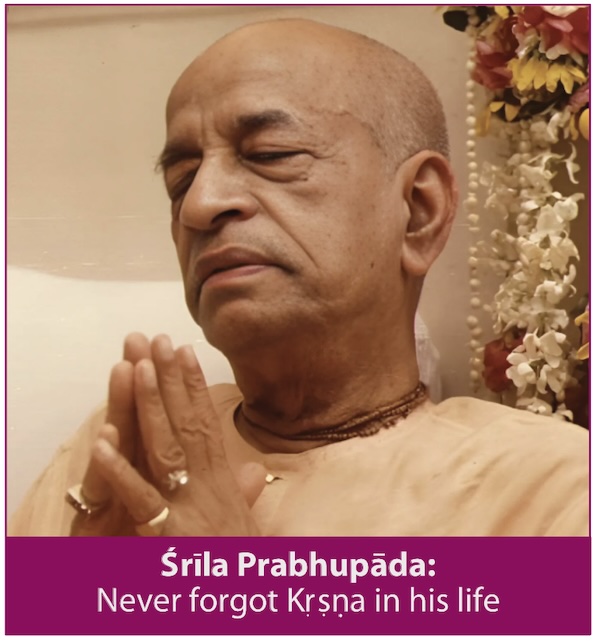
"So far my present life is concerned, I do not remember any part of my life when I was forgetful of Krsna."
Thus, here we have a case of Srila Prabhupada directly telling MG to not do something, and he still does it! In this, MG follows the example of others who were also directly instructed by Srila Prabhupada to not do something, but who then still disobeyed this direct instruction. For example:
a) GBC voted-in guru HH Hridayananda Dasa Goswami went on to learn Sanskrit, despite having specifically been prohibited from doing so directly by Srila Prabhupada (see BTP 57, "Guru Hoaxer Confirms BTP Article").
b) GBC voted-in guru HG Sankarsana Dasa disobeyed Srila Prabhupada's instruction to avoid the tendency for playing guitar and writing songs (see BTP 61, "Srila Prabhupada's Words Expose Ambition").
Supporters of the GBC's guru hoax often argue that a "living", meaning physically present, diksa guru is needed to "explain" matters, otherwise one can misunderstand. And that having such a "living guru" means we can personally question him. However, the above examples show that it does not matter whether or not the "living" guru explains instructions "in person" directly, if one still refuses to accept them! Whereas, others who never had any physical contact with Srila Prabhupada are still following him very strictly.
Subscribe for FREE to Back To Prabhupada Magazine - Click Here
Guru-Tattva
Return to IRM Homepage