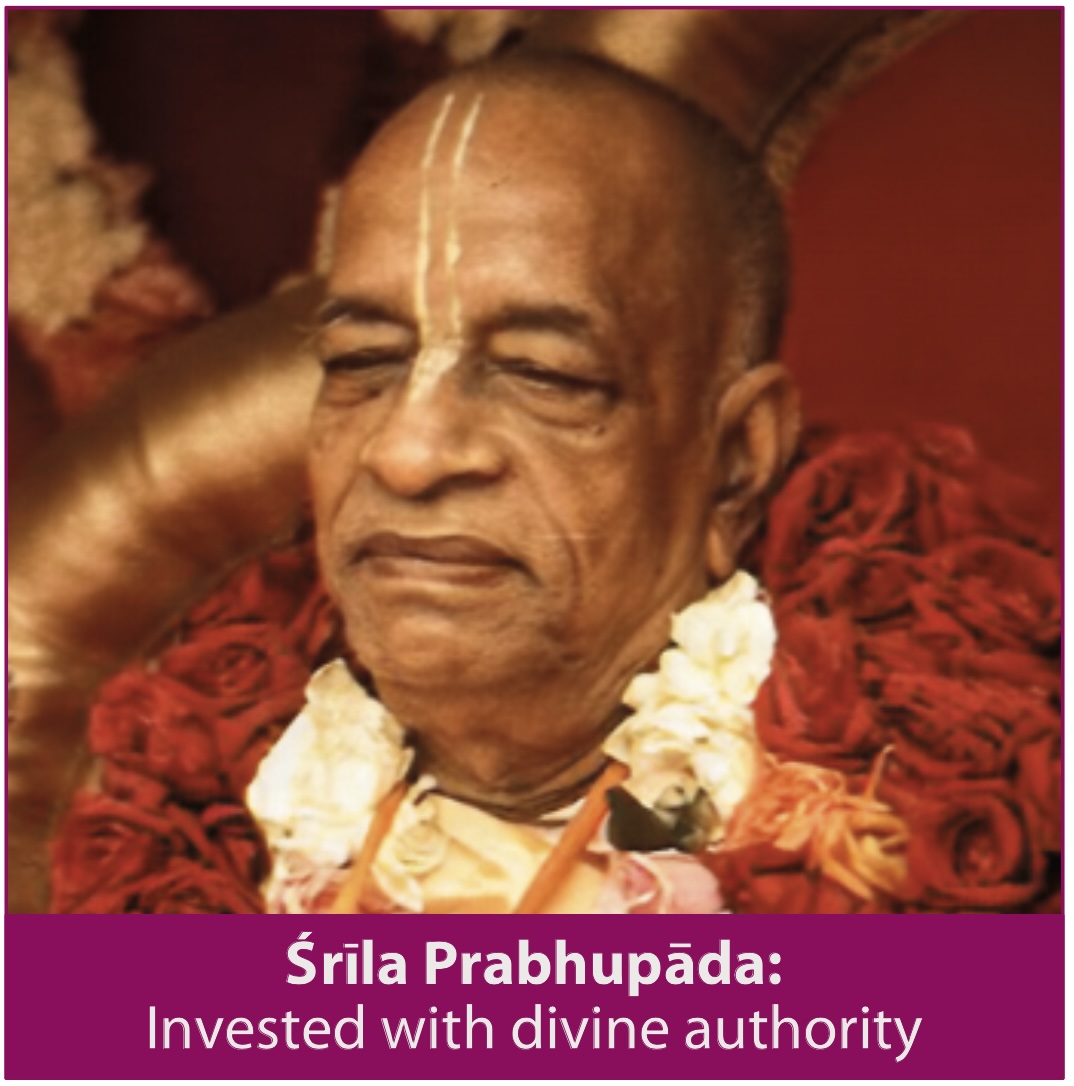
t is not disputed that Srila Prabhupada established a GBC to manage ISKCON. However, we will now prove that the very fact Srila Prabhupada established a GBC means it is spiritually and philosophically impossible for Srila Prabhupada to have also ordered successor diksa gurus in ISKCON.
Good as God
It is a basic teaching that the diksa guru is to be treated and respected "as good as God":
"The guru should be treated as good as God. This is stated in all the sastras."
(Srila Prabhupada, Letter, 29/1/76)
"offering respect to guru. That means they are learning how to offer respect to God. [...] In all the sastra, Vedic literature, guru is described as good as God."
(Srila Prabhupada, Lecture, 22/8/73)
Thus, to treat and respect the guru as good as God means that one must also regard the guru as having the authority of God. This is a standard understanding even in ISKCON, as admitted in the HR paper:
"Disciples have a formidable arsenal of quotations from Prabhupada and scripture that glorify gurus. [...] Many devotees who have read Prabhupada's books have reached the conclusion that they must regard a guru as having the authority of God."
Greater than God challenge
The definition of the GBC, which was given and approved during Srila Prabhupada's physical presence, stated that the GBC would have authority for "delegating authority", "maintaining spiritual standards", and "defining sphere of influence" for everyone in ISKCON (Definition of GBC, GBC Resolution 1, 1975). Thus, if successor diksa gurus to Srila Prabhupada were to exist in ISKCON, then the GBC would need to be able to exercise its authority over them and all their activities in order to manage them. But this would require the GBC to effectively have an authority "greater than God", since we have already established that diksa gurus must be respected as having the authority of God. And, if the GBC does not possess such authority, then it means that it could not manage diksa gurus, and thus it is not possible for a GBC and successor diksa gurus to co-exist. Which would mean that since Srila Prabhupada did establish a GBC to manage ISKCON, he did not authorise such successor diksa gurus. We now present 6 proofs which show that the GBC does not, and cannot, possess such authority over successor diksa gurus.
The 6 Proofs
1) Not greater than God
On consulting Srila Prabhupada's teachings, we do not find Srila Prabhupada granting such extraordinary "greater than God" authority to the GBC, which would be necessary if he had ordered successor diksa gurus. Indeed, Srila Prabhupada demonstrated with his own example that a GBC is subordinate, not superior to, a diksa guru's authority:
"we are managing our Krishna Consciousness Movement by the Governing Body Commission, GBC. We have got about 20 GBC's looking after the whole world affair, and above the GBC I am there."
(Srila Prabhupada, Letter, 30/6/76)
2) Admits not greater than God
The GBC itself agrees that it does not possess such "greater than God" powers. The GBC paper written specifically to address the issue of how diksa gurus can exist within a GBC system, describes the GBC's authority as being not even on a par with God's authority, never mind superior to it:
"When we use the word "authority" in the context of the managerial structure, we do not mean an absolute, infallible authority – such as the authority of scripture".
(Understanding ISKCON's Lines of Authority)
3) Cannot be managed
The GBC's authority to manage everyone in ISKCON gives it the authority to also discipline them, as that is an essential part of managing – controlling those under your management. But such managerial authority cannot be exercised over a diksa guru:
"It is also an offense to consider an empowered Vaisnava an object of disciplinary action. It is offensive to try to give him advice or to correct him."
(Nectar of Instruction, Text 6, purport)
4) Must be free as God
The diksa guru must be free to act as God is free to act, and thus must be free of a managerial authority just as God is:
"An authorized spiritual master is as good as Hari, the Supreme Personality of Godhead. If Hari is free to act as He likes, the empowered spiritual master is also free. As Hari is not subject to the criticism of mundane rules and regulations, the spiritual master empowered by Him is also not subjected."
(Cc., Madhya-lila, 10.136, purport)
5) Cannot function as diksa guru
The diksa guru has the key function of engaging his disciple in service:
"The expert spiritual master knows well how to engage his disciple's energy in the transcendental loving service of the Lord, and thus he engages a devotee in a specific devotional service"
(Cc., Adi-lila, 1.35, purport)
But, if managed by a GBC, such power would be taken from the diksa guru, which is the case at present, as demonstrated by ISKCON Laws 405 G (GBC Resolutions, 1999) and 6.4.3.5.
6) Cannot function as a diksa guru - 2
The diksa guru's key activity is preaching:
"Generally, the guru's symptom is that he's a perfect devotee. That's all. And he's serving Krsna by preaching His message."
(Srila Prabhupada, Talk, 27/2/72)
But, if managed by a GBC, such power can be strictly controlled and even stopped, as has been the case in practice with some of the current GBC gurus, who have even been "banned" from preaching in certain countries.
Conclusion
1) It is conclusively proven from every possible angle that the GBC does not have the necessary "greater than God" power that would allow it to manage, and thus co-exist, with successor diksa gurus.
2) Hence, it is conclusively proven, based on "God's authority" no less, that Srila Prabhupada could not have ordered successor diksa gurus.
Subscribe for FREE to Back To Prabhupada Magazine - Click Here
Return to GBC Index
Return to "Qualification of Guru" Index
Return to "Succession" Index
Return to IRM Homepage