
Back To Prabhupada, Issue 84, 2025
In the last issue, we had noted the latest high profile GBC voted-in guru, Trivikrama ("TV"), to "fall down". By "fall down", we are only referring to GBC gurus who have been caught breaking the regulative principles (in TV's case, illicit sex). We have already documented that all GBC gurus are already fallen by having become GBC gurus and thus displacing Śrīla Prabhupāda as ISKCON's dīkṣā guru, without Śrīla Prabhupāda's authorisation. TV's falldown has caused more panic than usual in ISKCON because:
1) He was one of ISKCON's longest serving sannyāsīs, having been one for over 50 years.
2) He was 84 when the fall happened.
The implication being if he can fall down then any GBC guru could fall, and no one is safe. ISKCON leaders have thus been scrambling to try to "explain" the falldown, and so maintain confidence in the GBC guru system.
Śrīla Prabhupāda clearly states that such a falldown is not possible if the person concerned is a bona fide member of the disciplic succession or paramparā:
"A bona fide spiritual master is in the disciplic succession from time eternal, and he does not deviate at all from the instructions of the Supreme Lord"
(Bg., 4.42, purport)
Consequently, the only possible "explanation" for a "guru" falling down is that they were never a bona fide member of the disciplic succession. We will see that ISKCON leaders fail to avoid this obvious conclusion in their "explanations".
GBC voted-in guru HH Bhakti Vikāsa Swami ("BVKS") was so rattled by the falldown that on 29/6/25, he issued a special lecture on it, titled "A Grim Warning". In this lecture, he tried to "explain" the issue by stating:
"Relevant here is Śrīla Prabhupāda's purport to Bhagavatam Canto 5, Chapter 14, Text 4:
"[...] the desire for family life continues, even after one has taken sannyāsa. Sometimes in our society, ISKCON, a person out of sentiment may take sannyāsa, but because his desires are not burned completely, he again takes to family life...\"
(SB, 5.14.4, purport)"
Though BVKS states this is "relevant" to explain the issue, it is actually irrelevant in that Śrīla Prabhupāda refers only to sannyāsīs who were not bona fide members of the disciplic succession. He does this by referring specifically to ISKCON sannyāsīs who had fallen down during his physical presence, when of course he alone was the dīkṣā guru in ISKCON.
BVKS then states the following:
"For our edification, śāstra relates the fall into sexual attraction of personalities as great as Lord Brahmā and Viśvāmitra."
However, Viśvāmitra was not even practising bhakti-yoga, never mind being a paramparā guru: SB, 5.17.3, purport.
Lord Brahmā was not in the paramparā when he had his problem:
"This extraordinary immorality on the part of Brahmā was heard to have occurred in some particular kalpa, but it could not have happened in the kalpa in which Brahmā heard directly from the Lord the four essential verses of Śrīmad-Bhāgavatam [...] after hearing Śrīmad-Bhāgavatam directly from the Lord, there was no possibility of such failures."
(SB, 3.12.28, purport)
And it is stated that after he became a member of the paramparā, there was actually "no possibility" of such falldowns, thereby confirming the point we quoted Śrīla Prabhupāda stating earlier – that paramparā gurus do not fall down.
Thus, the issue of paramparā gurus falling down is not even mentioned.
Meanwhile, ISKCON India decided to "explain" the issue by a posting on the website of their "scholars" board on 11/8/25, titled "Addressing Allegations and Guru Standards in ISKCON". They claim:
"Prahlādānanda Mahārāja noted that [...] since 1992, only three sannyāsis have faced significant issues, a marked improvement from earlier decades when falldowns were more frequent."
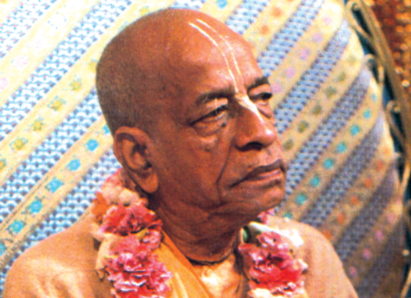 |
Śrīla Prabhupāda:
A bona fide guru can never fall down
|
Thus, the approach taken is to minimise the issue by claiming that not as many sannyāsīs fall down anymore. However, the actual facts are that since 1992, at least 34 persons have been removed from acting as GBC gurus, of whom 26 were sannyāsīs. This is many more than the "3" mentioned. But regardless of the figures, this still does not "explain" why supposed paramparā gurus should have fallen in the first place.
Next, the IISB paper quotes the following from the Mahābhārata –
"Even a guru who has become arrogant, who no longer knows what is proper or improper, and who has deviated from the righteous path - such a guru should be renounced" (Udyog Parva).
– claiming that this proves that:
"The Vedic shastras themselves acknowledge that gurus can falter."
They add that:
"Prabhupāda himself quotes this same shloka in his purport to Srimad-Bhagavatam 8.20.1, in which he explains the reason for Bali Mahārāja refusing the order of his guru, Shukracharya."
Śrīla Prabhupāda does quote this śloka, but then immediately after quoting it states that the guru the śloka speaks of is as follows:
"Śrīla Jīva Gosvāmī has advised that such a useless guru, a family priest acting as guru, should be given up, and that the proper, bona fide guru should be accepted."
(SB, 8.20.1, purport)
Thus, this refers to a useless family priest acting as guru, not a paramparā guru, and indeed one is advised to then actually take up a "proper bona fide guru". Which makes perfect sense, since in the statement below which refers to Śukrācārya, who is mentioned in the quote above as the guru to be rejected, he is described as such a useless family priest himself:
"A real brāhmaṇa would not become a priest for atheistic men."
(SB, 7.5.1, purport)
No evidence is presented from Śrīla Prabhupāda or śāstra to show that bona fide paramparā gurus fall down. Thus, the fact remains that if a "guru" does fall, he was not a bona fide paramparā guru to begin with.
Subscribe for FREE to Back To Prabhupada Magazine - Click Here
Return to "Trivikrama Swami" Index
Return to "HH Bhakti Vikasa Swami" Index
Return to "HH Prahladananda Swami" Index
Return to "ISKCON India Scholars Board" Index
Return to "GBC Body" Index
Return to IRM Homepage