he previous article documented Srila Prabhupada’s consistent teaching that a guru must be liberated. As part of that consistency, Srila Prabhupada made the same point earlier in a letter written on 26/4/68:
"he is not a liberated person, and therefore, he cannot initiate any person to Krishna Consciousness (1) [...] Generally the spiritual master comes from the group of such eternal associates of the Lord; but anyone who follows the principles of such ever liberated persons is as good as one in the above mentioned group. (2) [...] A person who is liberated acharya and guru cannot commit any mistake, but there are persons who are less qualified or not liberated, but still can act as guru and acharya by strictly following the disciplic succession." (3)
Thus, Srila Prabhupada again states:
a) That the spiritual master must be liberated – sentence (1) above.
b) In sentence (2) above he states:
i) Though generally the spiritual master is a nitya-siddha – "eternal associates of the Lord" who are "ever liberated";
ii) One who follows the principles of such persons can also be a spiritual master, i.e. sadhana-siddha.
c) Srila Prabhupada later repeats point b) in sentence (3) above:
i) He refers to those who are "not liberated", which in the context just given means not "ever-liberated" or "not always liberated", i.e. not nitya-siddha;
ii) One who follows strictly can also become a spiritual master, i.e. sadhana-siddha.
However, the underlined part of sentence (3) has been used by the GBC as "proof" that Srila Prabhupada authorised non-liberated persons to become diksa gurus or acaryas. But, this would mean that Srila Prabhupada:
i) Contradicts his statement that the guru must be liberated which he had just made earlier in the same letter.
ii) Contradicts himself repeatedly in letters written 1 and 2 years later (quoted in the previous article) where he addresses the exact same subject matter and emphatically states repeatedly that the guru must be liberated.
Whereas, accepting that Srila Prabhupada is talking about sadhana-siddhas rather than conditioned souls in the underlined statement, is consistent with everything else Srila Prabhupada said in the same letter, as well as in the two subsequent letters.
Thus, the GBC's argument for its non-liberated guru program depends on imposing multiple contradictions on Srila Prabhupada. The GBC also claims that the following quotes refer to orders to become diksa gurus:
"One who will pass this examination will be awarded with the title of Bhaktivedanta. [...] Those possessing the title of Bhaktivedanta will be allowed to initiate disciples. Maybe by 1975, all of my disciples will be allowed to initiate and increase the numbers of the generations."
(Srila Prabhupada, Letter, 3/1/69)
"By 1975, all of those who have passed all of the above examinations will be specifically empowered to initiate and increase the number of the Krishna Consciousness population."
(Srila Prabhupada, Letter, 12/1/69)
The letters quoted both refer to the same set of examinations on Srila Prabhupada's books, which were to take place between 1970 and 1971 (as stated in the first letter).
These exams were to be attended by every single devotee:
"There will be an examination and everyone will have to appear to take this examination"
(Srila Prabhupada, Letter, 1/2/69)
Further, these exams were supposed to be introduced as a permanent system for everyone who joined in the future:
"I wish to introduce this examination system so that in the future our students may not remained unconcerned with these books we are publishing."
(Srila Prabhupada, Letter, 12/1/69)
Hence, someone who joined ISKCON in 1973-74 say, and passed the exams, could, by the above quotes, also "initiate" in 1975.
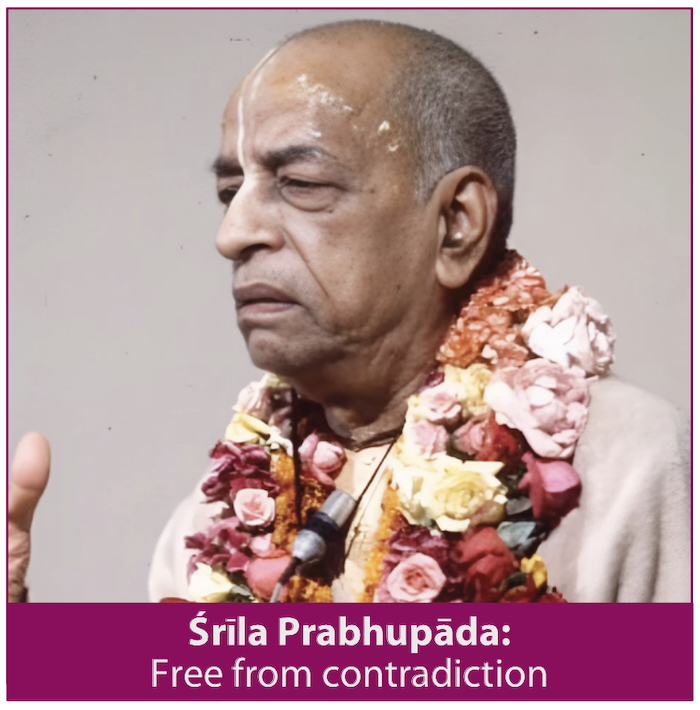
In the letters quoted in the previous article and in the previous column, Srila Prabhupada emphasises repeatedly that the spiritual master must be liberated. Yet, not even the GBC claims that one becomes an instantly liberated person as soon as one passes some exams. Thus, the only way the above "exam" quotes were referring to all of Srila Prabhupada's disciples becoming diksa gurus, is if the GBC again claims that Srila Prabhupada contradicted himself: by stating repeatedly between 1968 and 1970 that the spiritual master must be liberated, and at the same time in 1969 also supposedly allowing everyone to become a diksa guru by just passing some exams rather than first being liberated.
 |
If all of Srila Prabhupada's disciples were allowed to become diksa gurus by 1975, as long as they passed the exams, then it would mean that Srila Prabhupada was proposing that all his disciples initiate in his physical presence. Which would mean they would be contradicting the "law of disciplic succession":
"during the lifetime of your Spiritual master you bring the prospective disciples to him, and in his absence or disappearance you can accept disciples without any limitation. This is the law of disciplic succession."
(Srila Prabhupada, Letter, 2/12/75)
And, since Srila Prabhupada states that he wants all of his disciples to initiate by 1975, this would not just be an exception to the law, but a wholesale deviation from the law.
However, an alternative is that, in these "exam" letters, Srila Prabhupada was referring to his disciples initiating in the future on his behalf. And that is exactly what happened:
1) Never mind "by 1975", not once during Srila Prabhupada's physical presence did a single disciple initiate as a diksa guru.
2) The exam letters state that his disciples will "initiate", and by 1977, some disciples were empowered to initiate disciples, with the July 9th, 1977 directive stating that they will be "performing initiations". But they did so on behalf of Srila Prabhupada.
Thus, the GBC again imposes multiple contradictions on Srila Prabhupada due to the desire to justify the guru hoax. But it is unnecessary, as alternative, consistent – rather than contradictory – explanations exist.
Subscribe for FREE to Back To Prabhupada Magazine - Click Here
Guru-Tattva
Return to IRM Homepage