
Back To Prabhupada, Issue 83, 2025
The important findings from the articles on pages 5 and 7 now allows us to present a comprehensive picture regarding "tradition" and historical precedent. (All emphases added.)
Tradition favours Ācārya system
We noted on page 7 that there are two contrasting systems of guruship. The "Single Ācārya" system has a single Ācārya and dīkṣā guru for the institution, as the supreme authority, as would be the case if Śrīla Prabhupāda remains the Ācārya and sole dīkṣā guru of ISKCON. Conversely, the current guru system in ISKCON has replaced Śrīla Prabhupāda with multiple dīkṣā gurus, all authorised and controlled by a governing board, which we referred to as MG or multiple guru system.
1) Institutional tradition
ISKCON is a world institution. If we wish to understand what the tradition would be for such an entity, the only comparable example we have is the Gauḍīya Maṭha ("GM"), the institution of Śrīla Prabhupāda's spiritual master, Śrīla Bhaktisiddhānta Sarasvatī Ṭhākura ("SBST"), which also made attempts to preach outside India. As we showed on page 7, the system here was to have a single Ācārya system after SBST's disappearance.
2) Historical precedent
The page 7 article also showed that there is no authorised precedent in the GM for a system where multiple dīkṣā gurus are under the authority of a GBC. The only precedent we have, as established by Śrīla Prabhupāda, is for a GBC to be under the authority of a singular Ācārya, as we showed in the article on page 6.
3) ISKCON leaders support Ācārya tradition
The GBC agrees with the above, admitting, as we quoted on page 7, that the "age-old tradition" involves authority being vested only in a single Ācārya.
4) ISKCON leaders agree ṛtvik traditional
Consistent with the above facts, ISKCON's leadership agrees that the "ṛtvik" system of initiation after Śrīla Prabhupāda's physical disappearance is "traditional":
a) ISKCON leader and GBC voted-in guru HG Ravindra Svarūpa Dāsa states in One Allegiance in Three Features that:
"the "posthumous ṛtvik" system – rest on an adherence to the traditional idea of leadership."
He states that this is because the traditional system requires an "autocratic figure", with a "compelling, charismatic presence" that can "personify the institution."
b) And the GBC states that this traditional "charismatic", "personifying" presence is exactly what Śrīla Prabhupāda continues to provide in ISKCON today, in its Śrīla Prabhupāda: The Founder-Ācārya of ISKCON booklet:
"His spirit pervades the institution as the essence of its own culture" (p. 21) [...] "a perpetual, indwelling active guiding and directing presence." (p. 22) "Śrīla Prabhupāda is the soul of ISKCON, so ISKCON is his body. And because the incorporation is a spiritual one, the body is non-different from the embodied." (p. 50)
Thus, the GBC also accepts that Śrīla Prabhupāda's physical absence would not affect him continuing to provide this traditional leadership found in the ṛtvik system.
GBC guru system is not traditional
As well as the support given for a ṛtvik system being traditional, the GBC admits that its own "MG" guru system is not traditional.
5) GBC guru system deviates from tradition
"ISKCON's ethos of multiple dīkṣā- and śikṣā-gurus serving under the auspices of a global managerial board is unique in the history of Vaiṣṇavism".
(GBC Resolution 318, 2014)
6) Doesn't follow historical precedent
There is also no historical precedent for paramparā dīkṣā gurus not being Indian-bodied, which most of the GBC dīkṣā gurus are!
Tradition is not applicable
Thus, if one insists on using "tradition" as a guide, it does not help those who support the GBC guru system. However, we can also show that tradition is not relevant.
7) Not applicable to ISKCON
"Whereas ISKCON is an unprecedented worldwide Gauḍīya Vaiṣṇava mission".
(GBC Resolution 316, 2009)
It is not even possible to apply precedent to ISKCON when the GBC has already admitted to it being unprecedented.
8) Ācārya does not follow precedent
We know that Śrīla Prabhupāda did not follow historical precedent as he states this himself, e.g. a sannyāsī taking part in marriages, which he states is "unique in the history" (Lecture, 22/8/73).
9) Teaching, not historical example
It has been claimed that where important spiritual principles are concerned, historical precedent is always followed. But then that is admitting that it is spiritual teaching rather than mere historical examples that matters. And there is no spiritual principle taught by Śrīla Prabhupāda that is violated by him remaining ISKCON's dīkṣā guru.
10) Did not authorise following tradition
But the simplest fact that renders tradition completely irrelevant is that Śrīla Prabhupāda never authorised tradition or historical precedent as a means to evaluate his orders. There is no instruction from Śrīla Prabhupāda wherein he states that his orders must always follow tradition or historical precedent.
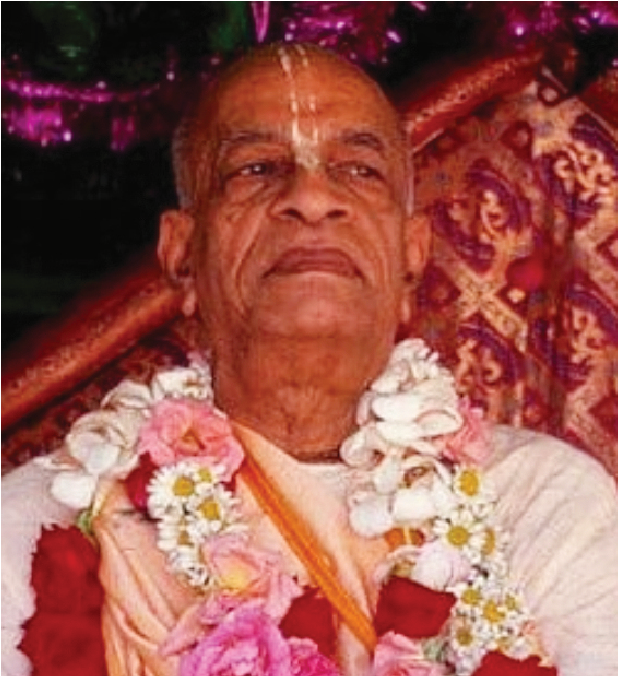 |
Śrīla Prabhupāda:
Traditional and sole Ācārya for ISKCON
|
Traditional self-contradiction
Thus, we have shown the GBC accepting that it should not use "tradition" or historical precedence to justify replacing Śrīla Prabhupāda as ISKCON's initiating Ācārya with the GBC guru system. Yet, that is exactly what the GBC does! It claims that the GBC guru system is justified:
"On the strength of our Vaiṣṇava tradition".
(GBC Resolution 409, 2004)
And that continuing to accept Śrīla Prabhupāda as the dīkṣā guru instead must be rejected because it:
"has never been practiced by the Gauḍīya Vaiṣṇava Sampradāya".
(GBC Resolution 73, 1990)
Conclusion
1) "Tradition" is not relevant in determining if Śrīla Prabhupāda should be replaced with GBC gurus.
2) Invoking tradition does not support the GBC guru system.
3) There are at least 10 reasons why invoking tradition or historical precedence would be the worst possible argument to use for supporting the GBC guru system. Yet the fact that it is probably the most cited argument in support, just shows how there is no sanction for it.
Subscribe for FREE to Back To Prabhupada Magazine - Click Here
Return to "Tradition" Index
Return to "Founder-Acarya" Index
Return to "GBC Body" Index
Return to IRM Homepage